Putting prioritized replay's segment tree on a GPU
The Tree Under Every Prioritized Replay
Prioritized experience replay (Schaul et al., 2016) samples transition $i$ with probability proportional to a priority: $P(i) = p_i^{\alpha} / \sum_j p_j^{\alpha}$. Three operations have to be fast for that to work at scale: update the priorities of a just-trained batch, draw a batch of indices proportional to priority, and read the global minimum priority (the importance-weight normalization needs it). The standard structure for all three is a sum tree: an implicit binary tree in a flat array of length $2n$, leaves holding the priorities, every internal node holding the sum of its children, the root holding the total. A point update touches one leaf-to-root path, $O(\log n)$; the total is a single array read; and sampling is a walk down the tree. A twin tree with min in place of sum serves the third operation.
In my Ape-X port, one MPI rank owns the replay buffer and nothing else, and this tree is nearly all of what that rank does: priority updates for every learner batch, plus intake batches from every actor, plus 512 sampling descents per learner step, against a buffer of $n = 2^{21}$ transitions. It is the hot path, it was pure Python, and this post is the story of moving it to C and then, with OpenACC, onto a GPU, including the parts where that was less straightforwardly a win than the project write-up's headline number suggests.
Sampling Is a Descent
The elegant bit of the sum tree is proportional sampling without ever materializing the distribution. Draw a uniform "mass" in $[0, \text{total})$ and walk down from the root: if the left child's sum exceeds the remaining mass, go left; otherwise subtract the left sum and go right. The leaf you land on is a sample drawn exactly proportional to priority.
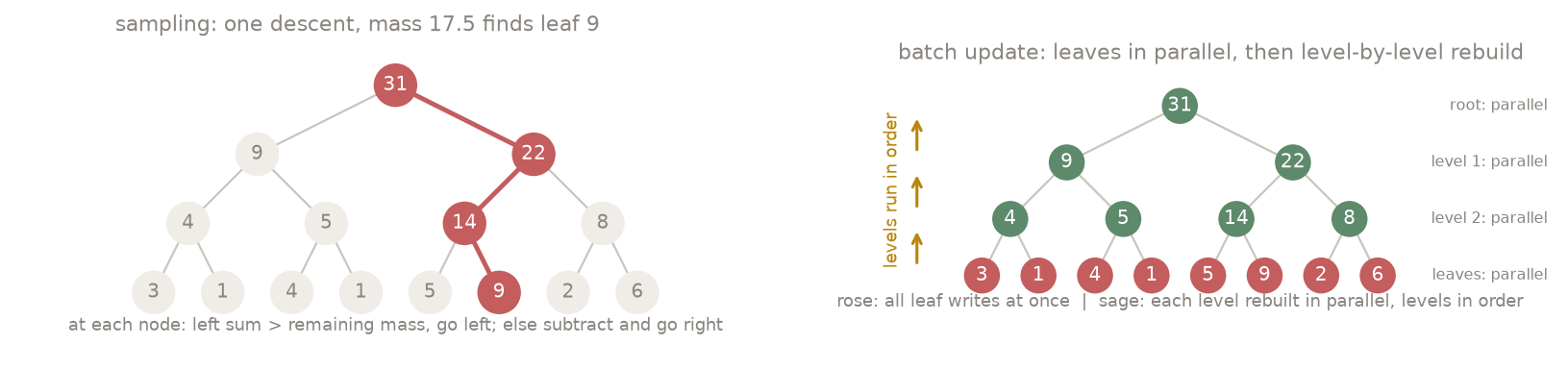
In C the descent is a dozen lines, and this exact function is the one the replay rank runs 512 times per learner step:
int st_find_prefixsum_idx(const Tree *t, double prefixsum) {
    int idx = 1;
    while (idx < t->cap) {
        if (t->data[2*idx] > prefixsum)
            idx = 2 * idx;
        else {
            prefixsum -= t->data[2*idx];
            idx = 2 * idx + 1;
        }
    }
    return idx - t->cap;
}
First Port: Pay the Interpreter Once
The first speedup has nothing to do with GPUs. The reference code calls find_prefixsum_idx in a Python loop, 512 times, and each call walks 21 levels of interpreted code. The C library exposes batched primitives instead: one ctypes call takes the whole array of masses (or indices, or priorities) as a zero-copy NumPy pointer and loops in C. Measured on the CPU build, batch of 512 descents against the $2^{21}$-leaf tree:
pure Python loop        : 430.7 us per batch
C descent, ctypes loop  : 131.0 us per batch   (3.3x)
C descent, one batch call: 19.1 us per batch   (22.5x)
The middle row is worth staring at: even with the descent already in C, calling it 512 times through ctypes costs 6.8 times more than calling it once with the batch. Most of that gap is pure foreign-function call overhead. Batching is not a GPU trick; it is an interpreter trick that happens to also be exactly what a GPU needs.
Second Port: Make the Update GPU-Shaped
Updates are where the algorithm itself has to change. The natural batch update, run the leaf-to-root propagation once per element, is hostile to a GPU in two ways: the $k$ paths are scattered, divergent walks, and they collide. Every path ends at the root, and near the top of the tree all $k$ updates write the same few nodes, which means atomics or serialization. So the C version does something different, and it is the pattern in the right panel of the figure: write all $k$ leaves at once (fully independent), then rebuild the internal nodes bottom-up, one level at a time, where every node within a level is independent:
/* Step 1: write leaves - all independent, fully parallel. */
#pragma acc parallel loop present_or_copyin(idxes[0:n], vals[0:n]) \
                           present_or_copy(t->data[0:2*t->cap])
for (int i = 0; i < n; i++)
    t->data[idxes[i] + t->cap] = vals[i];

/* Step 2: bottom-up rebuild, one level at a time. */
for (int level = t->cap / 2; level >= 1; level /= 2) {
    #pragma acc parallel loop present_or_copy(t->data[0:2*t->cap])
    for (int i = level; i < 2 * level; i++)
        t->data[i] = t->data[2*i] + t->data[2*i+1];
}
Note what was traded. Per-element propagation does $O(k \log n)$ work; the rebuild does $O(k + n)$, touching every internal node whether or not anything beneath it changed. The batch path deliberately does more arithmetic to get work that is conflict-free, coalesced, and level-parallel. The same source file compiles two ways: gcc ignores the pragmas and produces a plain CPU library; nvc -acc offloads both phases to the GPU. One algorithm, one file, two machines.
The Race Condition Worth Writing Down
The first version of that rebuild had the parallel loop pragma on the outer loop, over levels. OpenACC obligingly ran all the levels concurrently, which means a parent could sum its children before the level below had finished writing them. The result was not a crash. It was a tree whose internal sums were slightly wrong, which means a sampling distribution that was slightly wrong, which in an RL system means nothing visibly fails and your agent just learns a little worse from subtly mis-prioritized data. The dependency structure of a tree reduction is between levels, never within one; the fix is exactly the code above, sequential outer loop, parallel inner loop, and it is the oldest lesson in parallel prefix computation (Blelloch's scan literature says it formally: level-synchronous, log-depth).
What caught it was not a sanitizer but the boring test harness: every operation compared against the pure-Python reference to machine precision, on every build. For numerical-systems code where wrongness is silent, a bit-for-bit oracle is worth more than any amount of code review.
Measuring the Trade Honestly
The project write-up reports the headline result on the cluster build: roughly two orders of magnitude over the original interpreted tree on batched updates and sampling, and the MPI system it serves wins actor intake throughput at every scale tested (1.39x to 2.31x over the ZMQ baseline). Preparing this post, I re-benchmarked the CPU build on my laptop (Apple silicon, clang, no GPU), sweeping the update batch size $k$ against all three strategies. The result is more interesting than the headline:
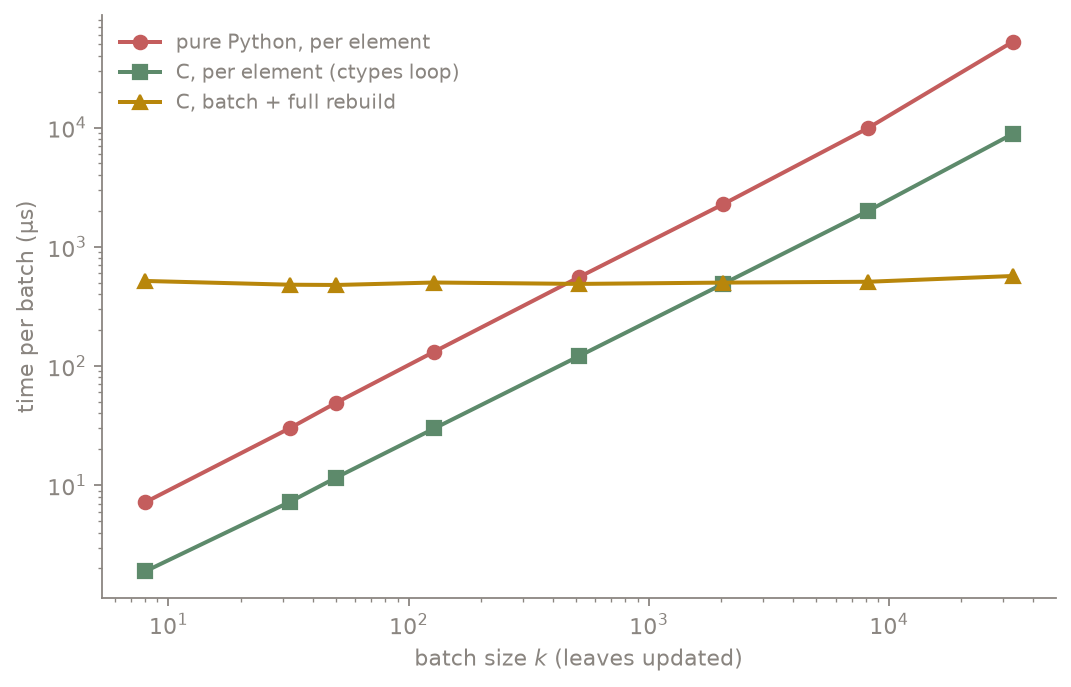
     k   pure Python   C per-element   C batch rebuild
     8        7.2 us         1.9 us         516.3 us
    50       49.2 us        11.6 us         477.7 us
   512      554.9 us       120.7 us         487.6 us
  2048     2279.3 us       489.4 us         500.2 us
 32768    52270.1 us      8819.7 us         568.0 us
The rebuild line is flat, as $O(k + n)$ with $n \gg k$ says it must be, and on a serial CPU it does not pay until $k$ approaches 2000. At the replay buffer's actual batch sizes, 50-transition intake batches and 512-priority learner updates, a plain C per-element loop beats the GPU-shaped algorithm by 41x and 4x respectively. On the CPU, the honest recommendation is a hybrid dispatch: per-element below the measured crossover, rebuild above it. The rebuild earns its keep on the machine it was shaped for, where the 500 microseconds of level sweeps spread across thousands of GPU lanes and the per-element path's conflicts and divergence have no good answer at all.
I like this result more than a clean victory. It is the whole CPU-versus-GPU tension in one flat gold line: the accelerator-friendly algorithm is often the worse serial algorithm, chosen anyway because it parallelizes, and the only way to know where the trade lands on a given machine is to measure it there. The pragmas-ignored-by-gcc design keeps both options open from a single source file, which in hindsight is the most defensible engineering decision in the whole component.
Where This Lives
The lineage, for anyone building the same thing: prioritized experience replay and the sum tree usage are Schaul et al. (2016); the distributed architecture this buffer serves is Ape-X, Horgan et al. (2018); the pure-Python tree this port started from descends from the OpenAI Baselines implementation that half the RL ecosystem inherited. The level-synchronous parallel reduction pattern is classical, formalized in Blelloch's work on scans. The full system context, the MPI transport that replaced a ZeroMQ stack and the wall-clock results, lives on the project page, and the write-up with scaling figures is in the repo's report. The benchmarks in this post were run for the post, on the CPU build, and the numbers above are the unedited output.
A prioritized replay buffer is a sum tree with three verbs: update, sample, min. Batching them into single C calls pays for itself immediately, mostly by dodging interpreter and FFI overhead. Putting the update on a GPU requires changing the algorithm itself, from $O(k \log n)$ scattered propagation to an $O(k + n)$ level-synchronous rebuild that deliberately does more work to make every write conflict-free. That trade is machine-dependent in a way a single headline number hides: measured on a serial CPU it loses below batch sizes of about 2000, and the race condition on the way there produced silently wrong sampling probabilities that only a machine-precision oracle test caught. Parallelize within tree levels, never across them, and benchmark on the machine you will actually run on.