The problem
Generative co-design methods like DiffuseBot let a diffusion model search a design space jointly with a differentiable behavior objective. Origami fold-space makes an unusually hard testbed for that idea: almost every random crease pattern doesn't fold flat at all, so feasibility is a measure-zero region of the design space, and for discrete mountain/valley assignments, deciding global foldability is NP-hard. A generator that only optimizes for behavior will walk straight off the feasible manifold. This project asks: can a learned feasibility surrogate guide a diffusion model onto that manifold, while a differentiable behavior certificate simultaneously co-optimizes performance?
Two certificates, not one
The method rests on pairing two learned/exact signals rather than one:
- Foldability certificate: a learned surrogate trained against an exact oracle (Kawasaki/closure conditions plus a global SAT solve for MV-assignment validity) that provides smooth guidance gradients where no analytic gradient exists.
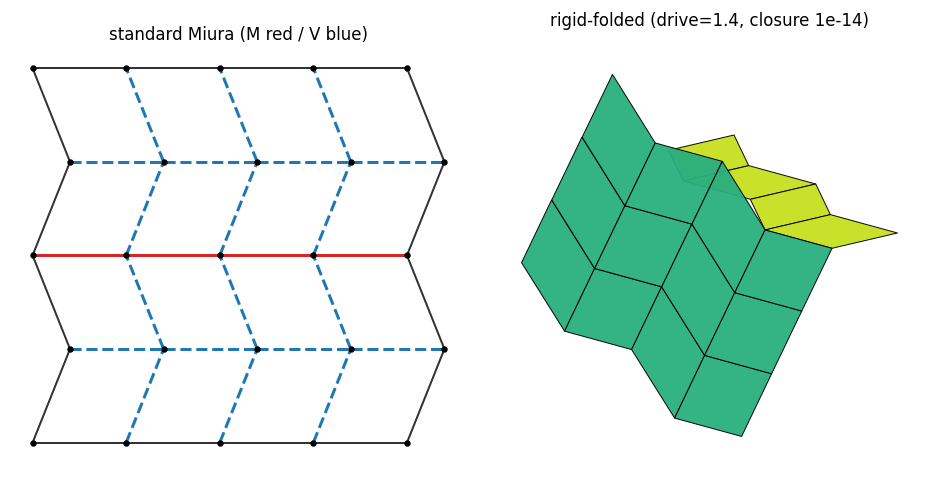
- Behavior certificate: a differentiable 3D rigid-fold simulator (validated to machine precision against closed-form and finite-difference checks) that scores task performance, e.g. a target deployed height.
Results, stage by stage
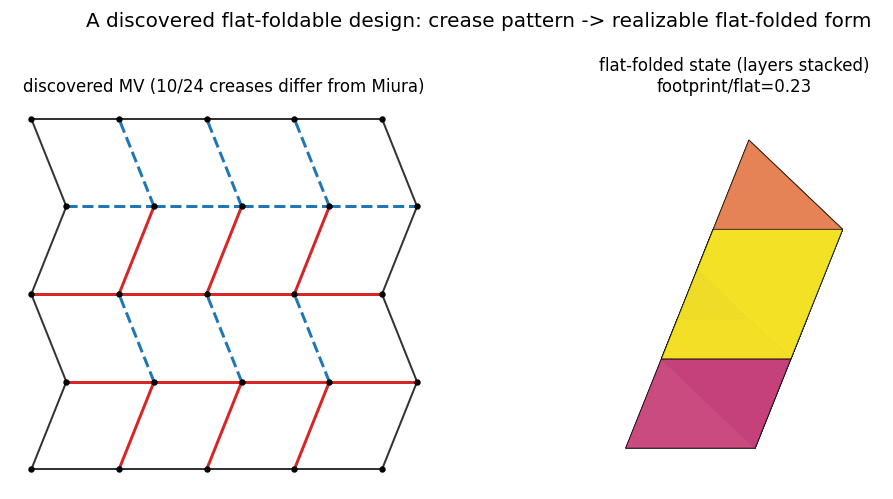
- M0 (learned feasibility, continuous & discrete). On continuous geometry, a calibrated surrogate (R²=0.997, AUROC=0.998) produces guidance gradients that match the exact analytic Kawasaki baseline, and guided diffusion lifts the exact-oracle feasible rate from 0.203 to 0.693. On discrete MV-assignment (the genuinely NP-hard substrate, where 93.8% of locally-valid patterns are globally non-foldable), a learned global surrogate (AUROC=1.000, AP=0.990 on a unique-disjoint split) still guides generation from 0% to 30% foldable.
- M1 (scaling via a size-agnostic GNN). A crease-graph GNN trained only on 3×3/4×4 patterns predicts foldability on unseen 5×5/6×6 patterns at AUROC 0.999-1.000 (Maekawa-only baseline: chance). Self-recurrence ("time-travel") guidance pushes generation at an unseen 5×5 size to 17% foldable, 2.6× the basic-sampler peak. The certificate transfers across size within a folding regime, but zero-shot transfer across regimes (e.g. sheared Miura to orthogonal grid) fails at near-chance AUROC; joint training is needed there.
- M2 (behavior + co-design). Behavior-only optimization (no feasibility term) reaches 0% foldable designs, the DiffuseBot-style failure mode this project set out to avoid. Adding the learned feasibility term restores 100% foldability at the same behavior target, and scheduling feasibility early / performance late Pareto-beats optimizing both simultaneously.
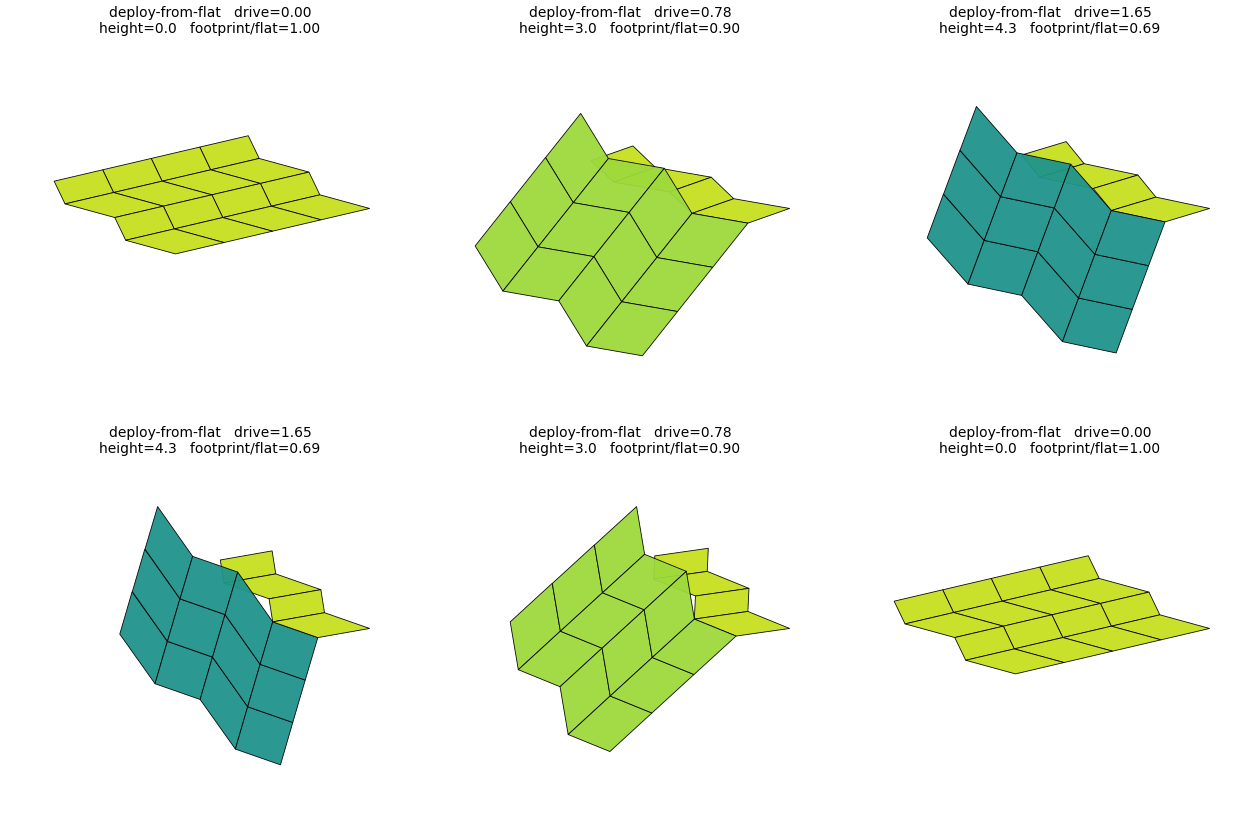
- M3 (deploy-from-flat). Co-design discovers an exactly foldable design that is a flat sheet at rest and a tall, 40%-compacted 3D structure at full actuation: folding doesn't just decorate the design, it enables the deploy-from-flat capability that a feasibility-blind search never finds.