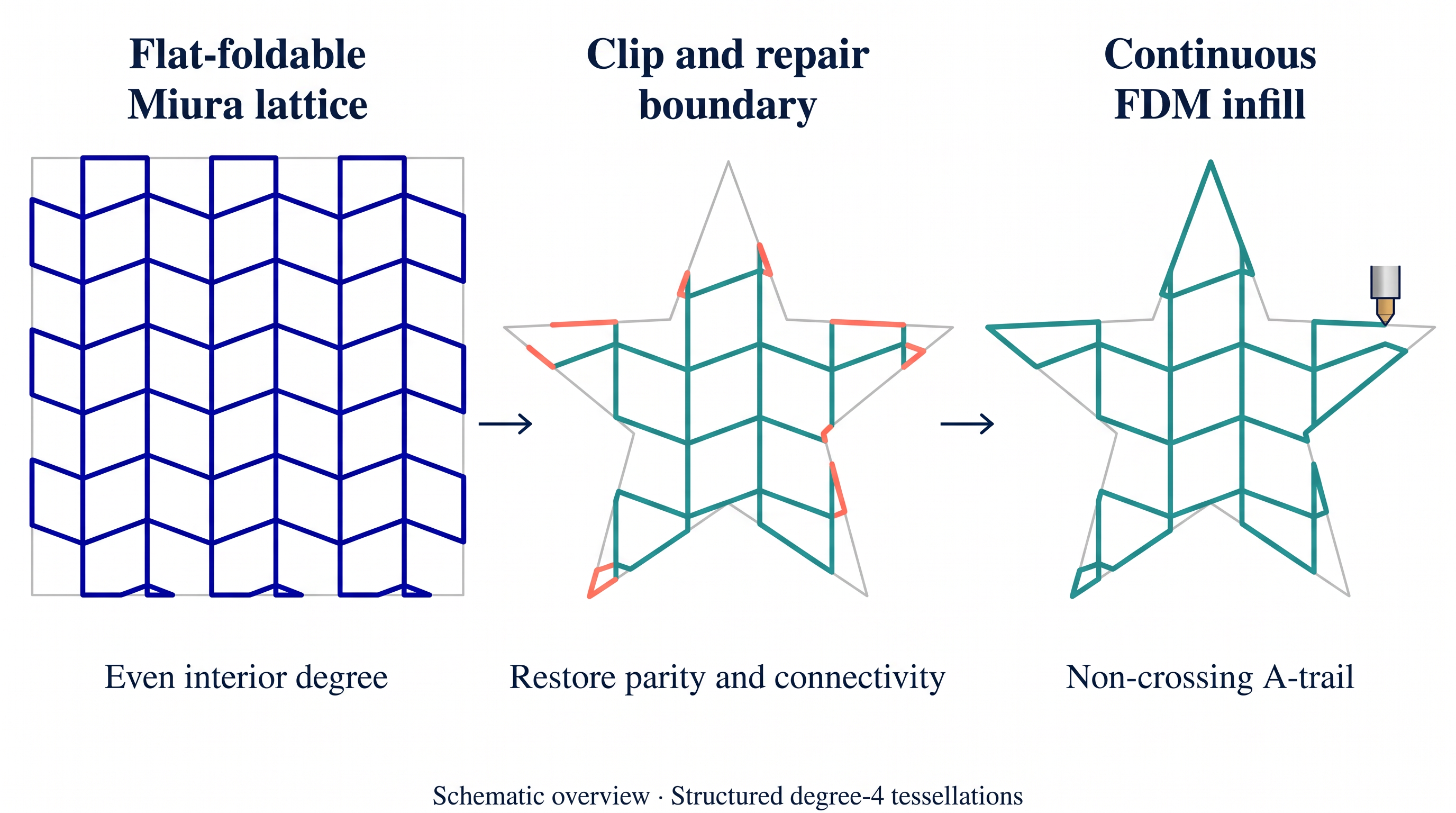
The idea
FDM print quality improves when a layer is deposited as a single, crossing-free, retraction-free stroke: every extra travel move and retraction is a place for stringing, blobbing, or a weak seam. Generating such a stroke for arbitrary infill geometry is hard; the state of the art (Gupta–Krishnamoorthy–Dreifus) forces the crease graph into one by quadrupling its edges, at real overhead.
Flat-foldable origami tessellations sidestep that cost because they already have the structure this problem is trying to manufacture. Maekawa's theorem says that at every interior crease vertex, the number of mountain folds and valley folds differs by exactly two, which forces every interior vertex to have even degree. A graph where every vertex has even degree is exactly a graph that admits an Eulerian circuit: a closed walk using every edge exactly once. So a flat-foldable crease pattern's crease graph is natively Eulerian, and a continuous toolpath falls out for free, with no refinement step.
The remaining question is whether that Eulerian tour can also be made crossing-free: the graph-theoretic object for that is an A-trail, an Eulerian circuit that never crosses itself under the pattern's planar embedding, determined by a per-vertex transition system. Turning "Eulerian" into "crossing-free and printable" is the theory work this thesis does.
Research questions
- RQ1 (Eulerianness for free). Which tessellation families get this property, and how much mesh-refinement overhead does it save versus the Euler transformation?
- RQ2 (Crossing-free traversal from MV). Does a valid mountain/valley assignment induce an A-trail directly?
- RQ3 (Boundary clipping). When a pattern is clipped to an arbitrary part outline, odd-degree vertices appear at the boundary: how cheaply can they be patched back to Eulerian?
- RQ4 (Low-curvature paths). Can Kawasaki's angle condition be used to minimize toolpath turning, which matters for print speed and quality?
- RQ5 (Mechanical anisotropy). Does the fold-line / deposition direction predictably set the printed part's mechanical anisotropy?
System: data format, slicer, and simulator
The thesis pairs the theory with three pieces of working software:
-
fold-toolpath (
tp:): a namespaced extension to the standard FOLD origami interchange format that adds the one object category it's missing for fabrication: an ordered walk over the crease graph, plus the transition system that certifies it's crossing-free. Includes a stdlib-only validator, an A-trail generator, a boundary-clipping tool for non-convex outlines, and a benchmark suite comparing toolpath length/turning/crossings against a grid-infill baseline. - origami-slicer: a static web app that slices an STL/OBJ and fills every layer with a single continuous origami toolpath, then emits G-code. The entire pipeline (slicing, clipping, A-trail generation) runs client-side in the browser via Pyodide/WebAssembly; nothing is uploaded, there's no backend, and it can be hosted on any static file service.
- origami_sim: a from-scratch GPU origami physics simulator used to validate that generated crease patterns actually fold the way the theory predicts. See the dedicated project page →
Physical validation
Beyond the software pipeline, the thesis includes a fabrication track: a
FillOrigami infill plugin (C++) integrated with a Bambu/Prusa
slicer, a coupon generator for standardized mechanical test geometries, and
G-code metrics tooling to measure real print quality (travel moves,
retractions, print time) against the grid-infill baseline on physically
printed parts.