Alan Royce Gabriel

Computational origami engineering

M.Tech student at IIT Madras working at the intersection of computational geometry, generative machine learning, and mechanism design. I use folding as a lens for manufacturing, generative design, and soft robotics. Below is a selection of ongoing research.

Time/accuracy Pareto front comparing stock, linear, and jointly-optimized flow compensation on a 20mm cube

flowmpc: Offline Model-Predictive Flow Compensation for FFF Printing

Filament compresses in the melt zone before it exits the nozzle, so printers under- and over-extrude through every acceleration and deceleration. A sliced G-code file is already the printer's entire future trajectory, so this project solves the same pressure-dynamics tracking problem a real-time controller would, once, offline, and bakes the result back into ordinary G-code for a stock, unmodified Bambu Lab X1C. The jointly-optimized speed and flow schedule dominates speed-agnostic compensation on the time/accuracy Pareto front and stays robust under model mismatch.

Model-Predictive Control Constrained Optimization FDM / Digital Fabrication System Identification
Greedy evaluation rollout of the trained Double-DQN agent playing Atari Seaquest

Ape-X MPI: Hybrid MPI/OpenACC Distributed Prioritized Experience Replay

A re-implementation of Ape-X (Horgan et al., 2018) that replaces the reference ZeroMQ/asyncio/multiprocessing transport, proxies, and queues with a single MPI_COMM_WORLD where every logical role is a fixed rank, launched with one mpirun command. The replay buffer's segment tree is ported to a C library with optional OpenACC GPU offload, giving roughly two orders of magnitude speedup, and the MPI port beats the ZMQ baseline on actor intake throughput and reward growth at every actor count tested.

Distributed Systems MPI Reinforcement Learning GPU Computing (OpenACC)
Miura crease pattern with a continuous zigzag toolpath traced through it

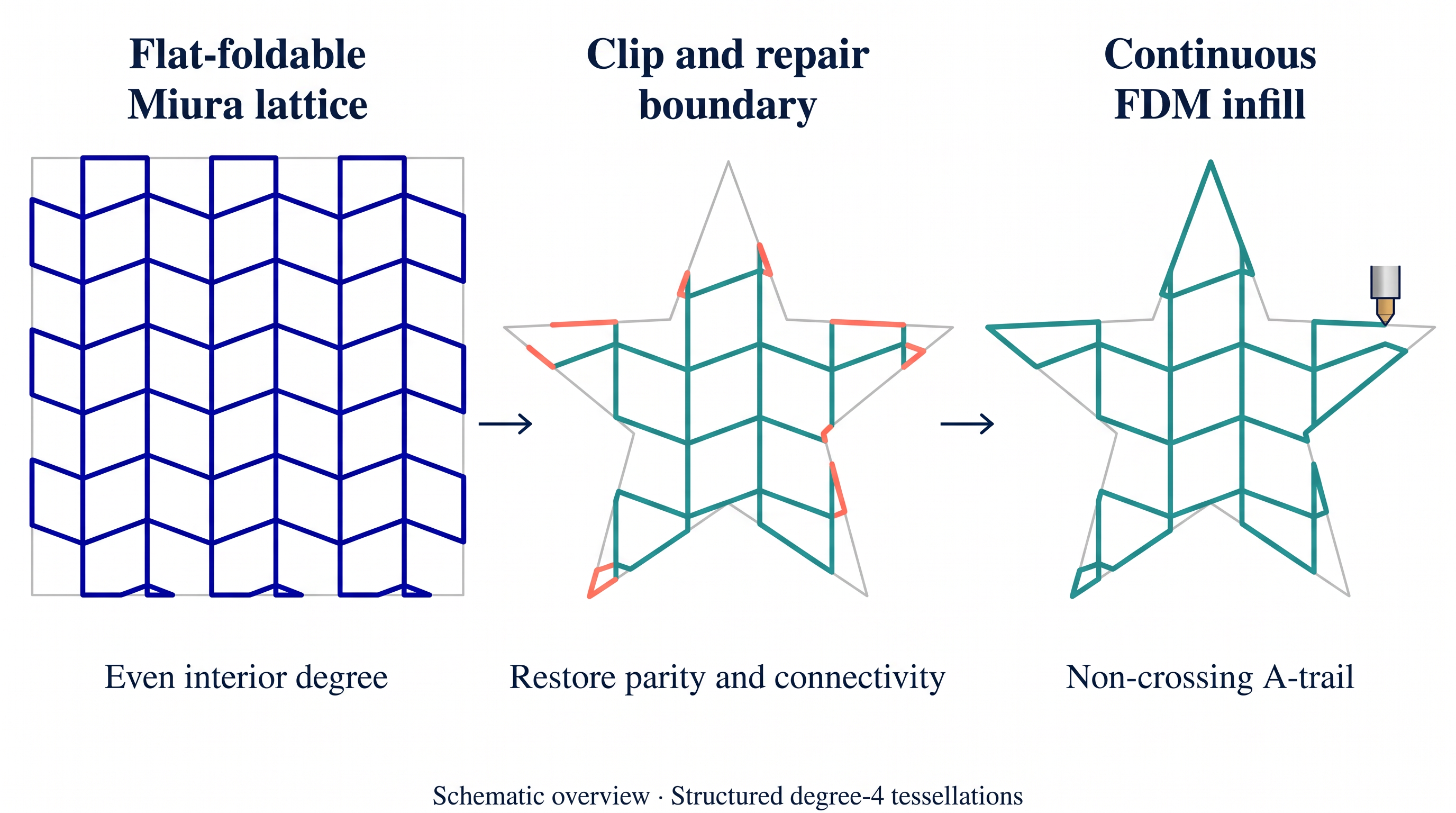
Flat-Foldable Origami Tessellations as Native Continuous Toolpaths for FDM

FDM print quality improves when a layer is deposited as one continuous, crossing-free stroke. Flat-foldable origami tessellations already have the structure this requires: by Maekawa's theorem every interior crease vertex has even degree, so the crease graph is natively Eulerian, and a printable toolpath falls out for free, with no mesh-refinement overhead. Includes a browser-based slicer, a FOLD-format extension for storing toolpaths, and a from-scratch GPU origami simulator.

Computational Geometry Graph Theory FDM / Digital Fabrication WebAssembly
A flat crease pattern deploying into a tall 3D corrugated structure

origami-diffuse: Feasibility-Aware Generative Co-Design of Origami Soft Robots

Origami fold-space is a measure-zero, NP-hard-to-decide manifold: almost no random pattern actually folds flat. This project builds a diffusion-based generator that stays on that manifold by combining a learned foldability certificate with a differentiable behavior certificate, so generated designs are simultaneously buildable and functional. Guided sampling lifts the exact-oracle feasible rate on unseen sizes from 0% to 30%, and co-design discovers a genuine deploy-from-flat morphology: a flat sheet that folds into a tall, compacted 3D structure.

Diffusion Models Constrained Generation Graph Neural Networks Differentiable Simulation
Three inverse-designed radial-leg linkages tracing grasp, bend, and iris-closing motions

Inverse-Designed Origami Linkages for Biohybrid Muscle Actuation

Engineered muscle tissue only contracts along one axis, yet grasping, multi-axis bending, and iris-like closing all need multi-directional output from that single input. This project designs a family of flat, fabricable "radial-leg" linkages and uses gradient-free inverse optimization (CMA-ES) to find one that converts a single physiological muscle contraction into a prescribed multi-directional motion, reaching sub-2mm tracking error and 4.5-7.7× displacement amplification, competitive with hand-tuned single-direction designs in the literature.

Inverse Kinematics CMA-ES Optimization Mechanism Design Biohybrid Robotics
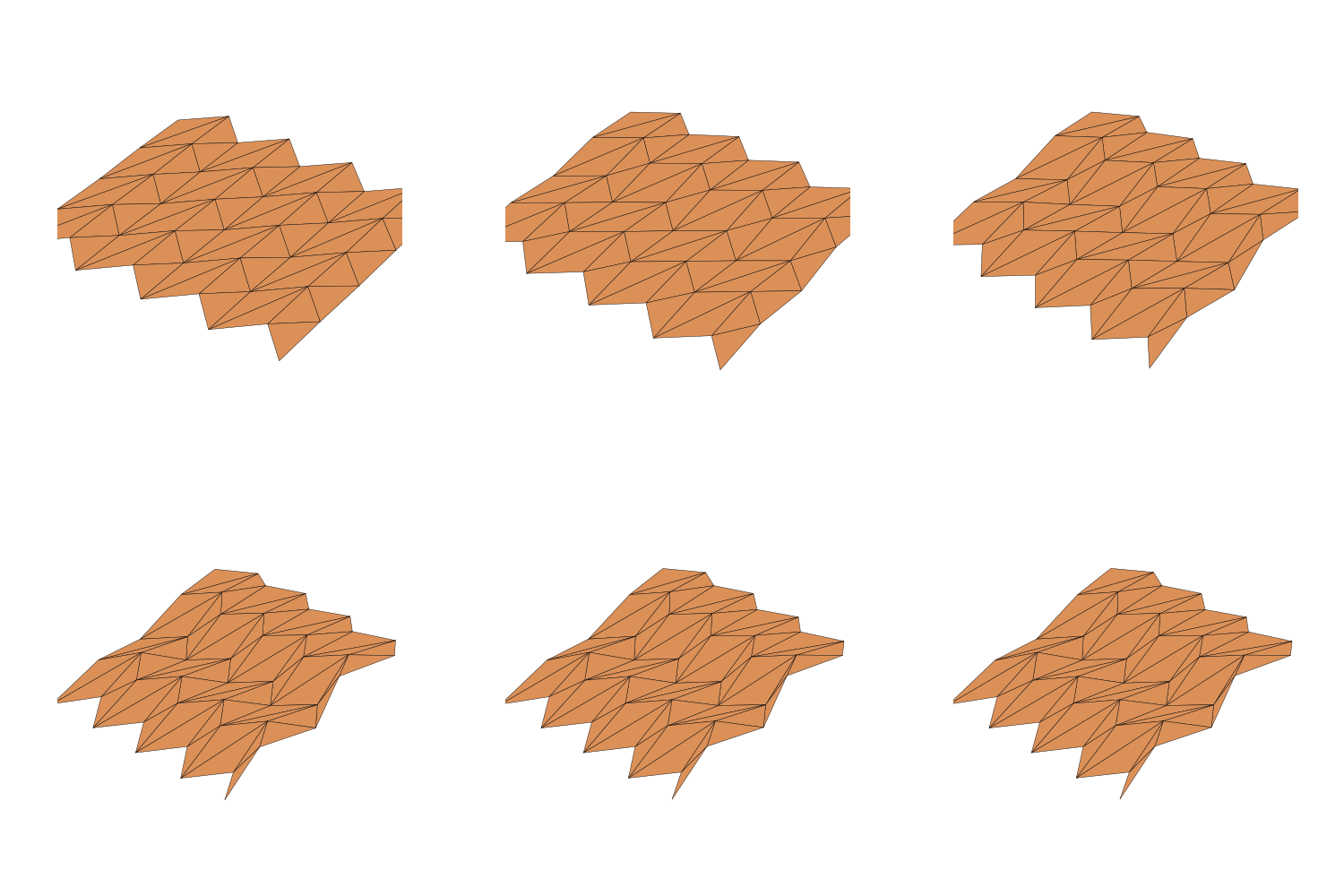
A Miura-ori crease pattern folding in the physics simulator

origami_sim: A GPU Origami Physics Simulator, From Scratch

A from-scratch reimplementation of Ghassaei, Demaine & Gershenfeld's GPU origami simulation method (the engine behind Origami Simulator): a crease pattern becomes a mass-spring mesh driven by four validated force types and an explicit physics loop, with a NumPy reference cross-checked to round-off against a Taichi GPU port that reproduces the paper's ~78× speedup at scale.

Physics Simulation GPU Computing (Taichi) Numerical Methods